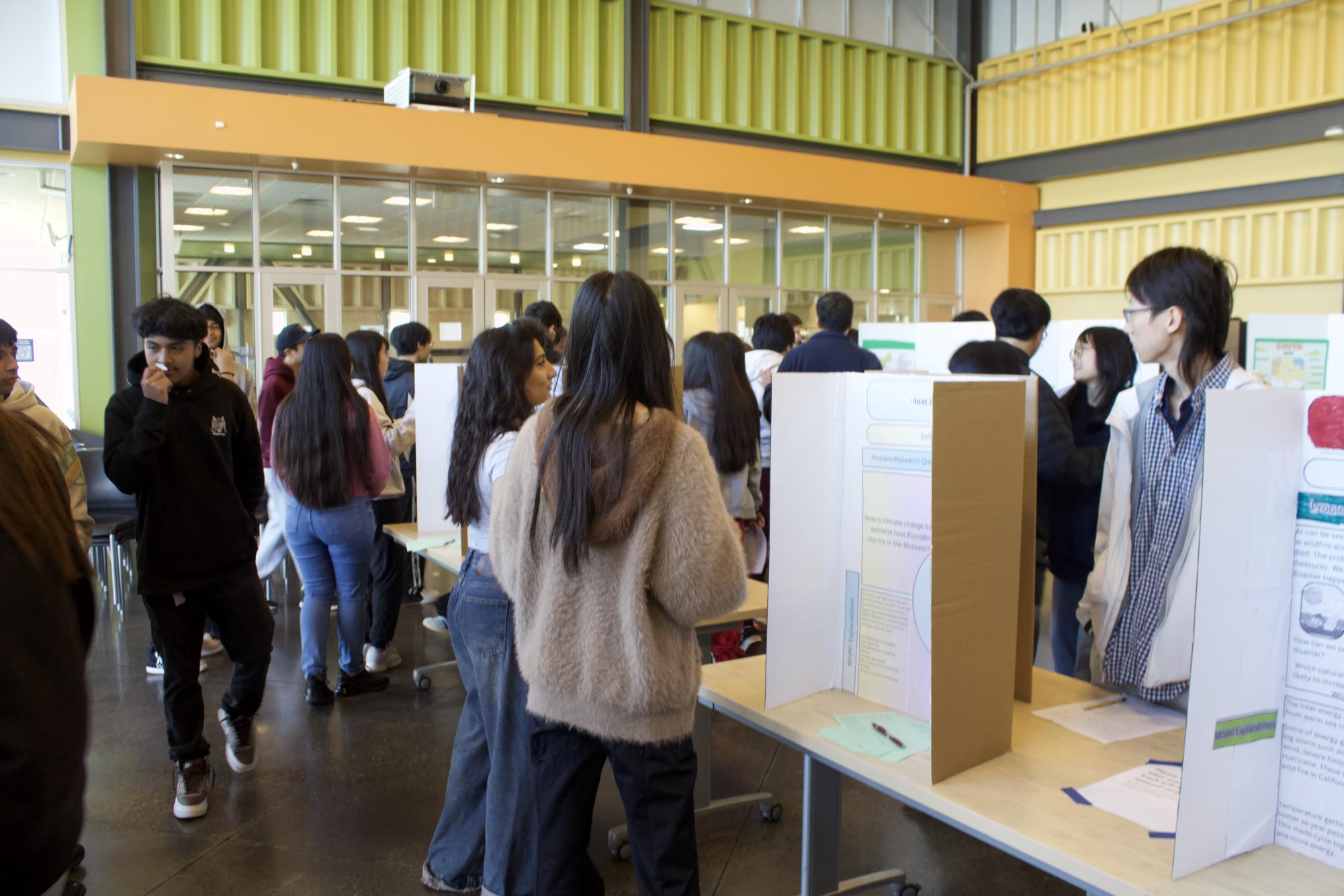
The cafeteria was filled with students and teachers from sheltered science classes during a science symposium event on Feb. 12.
Following low ELPAC scores from last year, the science department hosted the event to help students practice their communication and literacy skills through presenting research projects to peers, physics teacher Kathleen Shreve said.
“One of the areas that [students] needed support in was speaking,” Shreve said. “So, as a science group, we decided to create an opportunity for students to speak, and it still feels like a normal science presentation setting.”
Physics:
For the sheltered physics class, presentations at the science symposium were centered around their unit on energy, Shreve said. Students had to create presentations about how climate change affected various regions of the country, using research and visual models of heat engines to understand how energy moves in and out through a complex system.
“One thing I really like about how the projects go is that [students] get really invested in the research, where they are looking for specific things. They are on the websites doing all this research, trying to find all of the data that they need,” Shreve said. “I love to hear them talk about their research, and I love to go around and hear what the other classes are doing.”
Sophomore Seita Matsumura said he enjoyed the preparation process and making the poster, which was about climate change in the Rocky Mountains.
“I enjoy [putting] stuff in order, coloring and fonts,” Matsumura said. “I’m an ELD student, so I tried to do my best to describe [what I’ve learned using] academic English.”
Biology:
With each student presenting about a specific disorder, the sheltered biology class conducted their research on genetics and applied their knowledge to draw visual models and convey their ideas, biology teacher Dara Alleyne-Levy said.
“I thought it was really nice to see students learn new things about [a specific genetic disorder],” Alleyne-Levy said. “Each pair of students was assigned a different genetic disorder and a different specific mutation, and they were asked to make a model of what happened between the gene with a healthy protein and a [mutated] protein.”
The project reinforced students’ knowledge of DNA and mutations through exploring disorders and their effects, Alleyne-Levy said.
“They were really able to see what that effect would be, and then what kinds of symptoms that could cause,” Alleyne-Levy said. “It also gave them the experience of seeing other kids work and presenting, being experts and being able to share that knowledge.”
Freshman Ryuki Ichii said he had fun learning about hemoglobin disorders, which his project centered around.
“My favorite part of this unit is sharing information we learn in the class with the other classes, like physics or science and society. [It’s] really interesting, and we can hear about the other classes,” Ichii said.
Science and Society:
Science and society teacher Joanne Quan said her students focused on energy and how human activity leads to climate change. Students had to synthesize what they learned and use a flow diagram to structure their speeches, which were presented during the science symposium, Quan said.
“Each pair had to investigate a specific human activity, such as land transportation, water transportation, clothing production and look at specific factors that would impact climate change,” Quan said. “Then they created the flow diagram, their research question and found graphs to support their claim.”
After connecting his project to prior experience, sophomore William Li found great interest in the research for his project, diving deeper into what he had previously learned about global temperatures rising.
“When I was a kid, I watched on social media [that] the temperature was going up in the world, and that was eight years ago,” Li said. “We still have this problem that we need to solve today, so that’s why I think I should share this with my classmates.”
Overall, the event was a big success, with all students sharing their knowledge while practicing speaking skills, Quan said.
“Normally, we see [the students talking] solely in class, but to have the pressure and excitement of presenting [publicly] to other teachers, other community members and our administrators, it really puts another layer for the kids to take pride in the work. That was really awesome to see,” Quan said.