A rush of panic and adrenaline hits me as the prompt for the cultural presentation, the final free-response question on the AP Chinese test, is unveiled. Recording starts after minimal preparation time, and ready or not you must speak, trying your best to construct sentences and keep up with your own train of thought.
Currently, every AP language test taker faces the daunting task of the surprise speaking prompt. Next year, though, College Board will replace the speaking portion with a course project that students complete over four months.
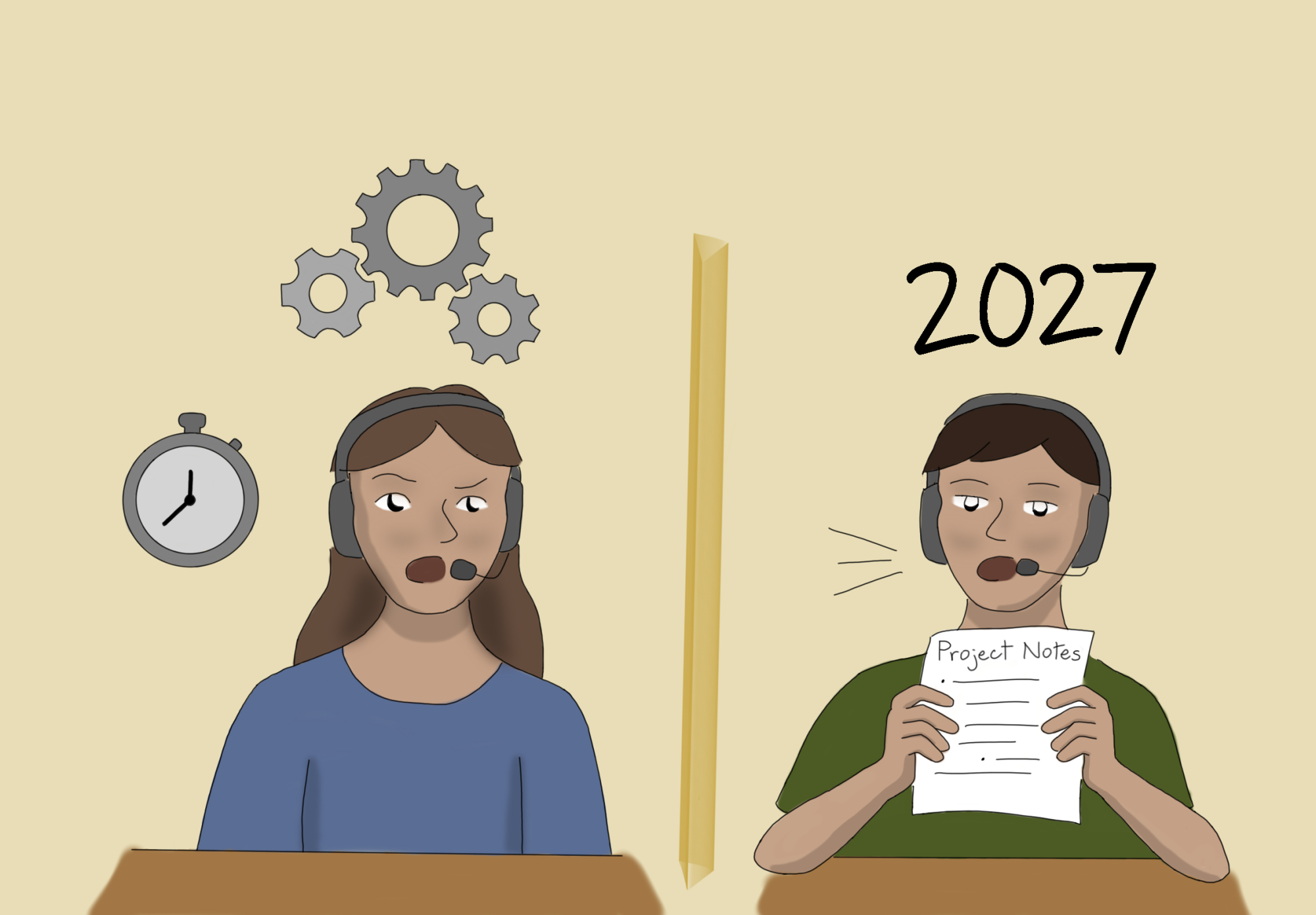
By implementing these changes, they lower the bar for students to be considered highly proficient. These shifts should be reworked to have more balanced, rigorous requirements that put both language use and conversational skills to the test.
For the new project, students will research a prompt released in January to create a three-minute presentation delivered live on exam day. The essential simulated conversation will be replaced with a four-question Q&A about the project.
Removing the impromptu speaking aspect of AP language tests leaves out an immensely useful metric for evaluating speaking skills.
In real scenarios, people normally use languages without prior preparation. Therefore, the impromptu section efficiently separates students who are competent speakers from those who can only operate in classroom environments.
The change was made to better align with college-level courses, according to College Board. However, since college language classes are more verbally demanding than those at the high school level, the new project culminates in a failure to hold students at a high standard as intended.
Currently, a group presentation for a Japanese project at HHS would take up to a month to complete, Japanese teacher Junko Birdsong said. Therefore, the new three minute presentation that provides students with ample time to prepare provides no challenge.
Additionally, the revised speaking section lacks a surprise factor, as the project Q&A can be anticipated ahead of time, as well. In this way, the test gives students too much preparation time, unlike impromptu formats, where their skills are put on display.
Languages are mostly used to communicate with fellow speakers, and a vital part of that is reacting to unexpected conversations and quickly deciding how to respond best. An AP language test should not negate the skill of spontaneity in the target language.
If College Board wants to simulate a college workload, they should increase the time pressure on students to complete the project by reducing the process to two months. Additionally, to keep a part of the speaking section a surprise, they should leave the current conversation unchanged so that one part tests cultural knowledge and the other evaluates raw speaking skills.
However the changes unfold, teachers should make sure they continue to incorporate more conversational emphasis in class. Students must be held accountable to learn a language to its fullest, even if the official AP test does not require it.