This year the language department welcomes four student teachers, all of whom are working while earning their college degrees. They were paired with HHS teachers through programs at their colleges and will spend one school year learning how to work and lead lessons in a classroom environment, student teacher Kelsey Darnielle said.
These teachers share unique goals they hope to accomplish, challenges they have encountered in their new roles and their motivations to pursue teaching.
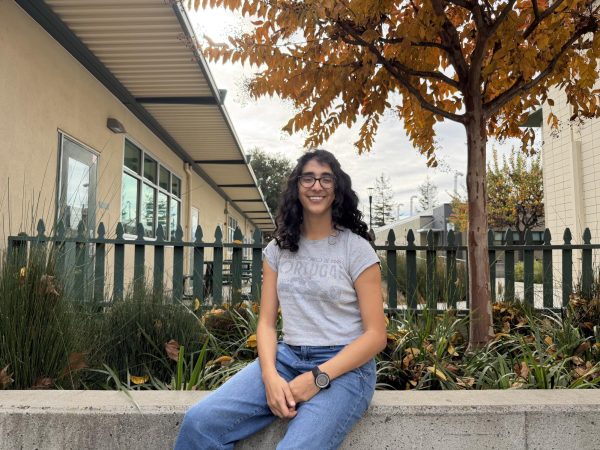
Kelsey Darnielle, Spanish, Stanford University:

(Photo by Maya Dutt)
Darnielle said she was inspired to teach because both Spanish language and Latin American history have always fascinated her. After graduating in education sciences from UC Berkeley, Darnielle said she was matched with Spanish teacher Gabriella Balas, who will train her for the year.
As a student teacher, Darnielle said she has encountered challenges with finding a balance between Balas’s teaching style and hers, as well as getting students to respect her authority.
“Especially if you’re a different kind of teacher than you’re cooperating teacher, it can be a bit awkward transitioning into your style of teaching the students,” Darnielle said. “Working through that dynamic of co-teaching is difficult, but usually, the students understand that they need to respect you just as much as they respect their cooperating teacher.”
After she completes her education, Darnielle hopes to teach Spanish and ethnic or social studies, as she is obtaining a credential for both subjects.
Oscar Rodriguez, Spanish, Stanford University:
In his youth, Rodriquez said he did not feel motivated to stay connected to his native language and only began to fully appreciate it later in life. Now, Rodriguez wants to help students stay connected to their second language instead of pushing it away like he did.
“[Teaching helped me] reconnect to my past language, my roots [and] my culture, while at the same time trying to do the same for kids,” Rodriguez said. “Many times, kids push away from speaking their home languages, and I want to reinforce keeping your language.”
After completing his bachelor’s degree in psychology and sociology from UCLA, Rodriguez said he is currently working to earn his teaching credential at Stanford University.
As he is simultaneously going through college, being a student teacher comes with the challenge of balancing teaching, learning and personal time, Rodriguez said.
“I have a partner, a little puppy and all these sets of responsibilities,” Rodriguez said. “Then I go to school, and I’m a student taking classes, worrying about final assignments, final projects, but then I can’t go home and just do work, because I also have to lesson plan.”
However, being a student teacher does give him some aspects of flexibility, especially with his teaching style, Rodriguez said.
“You can practice all you want, see all the methods you want to try out and find who you are as a teacher,” Rodriguez said. “Once you’re in the field, it’s really [strict] as a full time teacher, but as a student teacher, you really have that flexibility of trying to find out what kind of teacher you are.”
After getting his degree, Rodriguez hopes to teach for about six years before transitioning to administrative roles.
Rei Tsai, Japanese, San Jose State University:

Tsai said he decided to pursue teaching because he spent time teaching English while living in Japan and found it to be a rewarding experience.
While teaching Japanese 1 and 2, Tsai said he discovered he needed to make his lesson plans flexible to accommodate various types of students’ needs while learning.
“It’s a job you have to adjust based on how the students are feeling,” Tsai said. “Sometimes they might not understand an assignment, so you’ll have to either change on the spot or instruct the students further on how to understand it. Not everything goes on schedule.”
Outside of learning the language, Tsai said that Japanese class should be about studying culture, as it can help students interact more respectfully with Japanese people.
“It’s learning about cultural differences and etiquette,” Tsai said. “When you actually travel to the country yourself or meet someone from that country, if you have an understanding of their culture and etiquette, it makes communication better.”
After he gets his degree, Tsai hopes to teach Japanese at a local school, but might look elsewhere in California if jobs are scarce.
Lingchan Xu, Mandarin, San Jose State University:
Though she came to the United States as a homemaker, Xu said she decided to get a college degree and work after her children grew up. Because she knew Mandarin, she majored in Chinese language and culture and decided to get a teaching credential for the language.
Paired with Jessica Bai, Xu said she appreciates the opportunity to put skills she learned in college to practice. The professors at San Jose State University set an example for her of what a good teacher looks like, Xu added.
“At SJSU, the professors set an example for me of what a good teacher looks like,” Xu said. “In the process of student teaching, I have the opportunity to practice the techniques I learned.”
In her student teaching experience, Xu said it has been challenging to design engaging activities tailored to students’ different levels of learning.
“You consider a lot of things, like how you design the entire class, and whether you are building students’ learning step by step, using their prior knowledge and building on their foundations to keep challenging them,” Xu said.
Now that she has experience working with students, Xu said she understands the importance of student-teacher relationships.
“In the past, I thought being a teacher was just about giving the lesson, but that’s only part of it,” Xu said. “Interacting with students and other teachers and managing other situations is also important. All in all, getting practical experience with student teaching is really useful.”
Xu said she hopes to become a public school teacher after completing her college education.
Editor’s note: This story includes an interview that was translated. We apologize for any errors.