As I enter the warp pipe into the dimly lit theater, I am met with a rush of dopamine but a sad attempt at an animated movie. “The Super Mario Galaxy Movie,” released April 1 as a sequel to Illumination’s 2023 film “The Super Mario Bros. Movie,” is nothing more than a colorful dumpster fire.
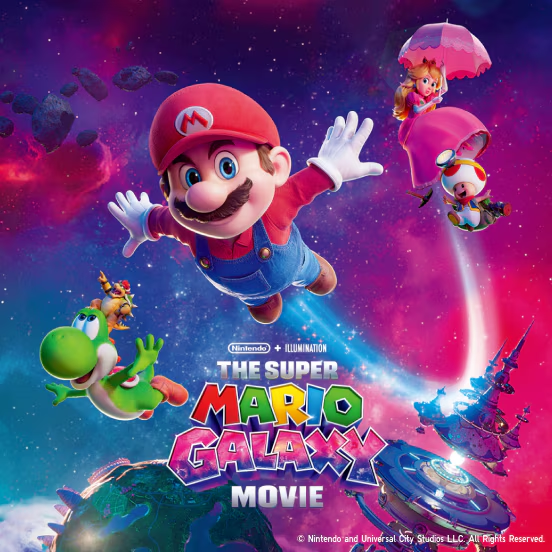
The animated film’s main plot explores how Bowser Junior captures Princess Rosalina to steal her magical power as Mario and friends journey beyond the Mushroom Kingdom to the galaxy to save her.
Just like the “Sing” and “Despicable Me” franchises, “The Super Mario Galaxy Movie” offers nothing but a flashy package of intellectual property from various games, music and characters. Seeming like no more than a collection of references, the movie is too unprofessional for even its intentionally cartoonish nature.
This is particularly frustrating with the movie’s unnecessary character additions like Star Fox. Star Fox barely has any connection to the Super Mario franchise, making their integral role in driving the plot feel like a blatant marketing ploy.
Behind these licensed characters, it relied on an exorbitantly paid cast of big names like Brie Larson as Rosalina and Donald Glover as Yoshi, who were paid upwards of $5 million each. However, their mediocre voice acting sounds much too personalized to represent the actual characters, failing to sugarcoat the film’s bland plot.
Throughout the nearly two-hour watch, “The Super Mario Galaxy Movie”’s directors try to juggle the stories of numerous characters at once, making the film feel like a compilation of wacky scenarios, rather than a cohesive story. From nonstop sequences involving duos of Mario and Luigi to Bowser and Bowser Junior, these subplots failed to develop characters or advance the plot in any meaningful ways.
Furthermore, each of these scenes only lasted around a dozen minutes, and the lack of transitions between them made the movie further devolve into something adjacent to a videogame speedrun. If creators wanted to abandon the long-form medium the movie should have excelled at, they could have simply released a series of short animations on YouTube.
Altogether, this obvious lack of direction and effort sends a clear message that Illumination is sacrificing quality to push soulless stimulation on an audience with declining attention spans.
Lastly, the movie lacked the moral messages abundant in previous Illumination films and Super Mario games. It did not make me feel courageous or inspired at any point, instead delivering a generic mood that betrayed the hero’s journey vibes I loved in those other projects.
Despite the mountain of celebrity fame surrounding “The Super Mario Galaxy Movie,” the film stands as a shallow and hyperenergetic yet ironically lazy mess of a production. In the absence of a story that positively contributes to the historic franchise, fans are better off sticking to the game.